
I crossed Blackfriars Bridge this morning to see the exhibition of photographs by Jim Grover in the gallery on the ground floor of the Oxo Tower. He has documented a year in the life of Kit Gunasekera, the vicar of St. James’s Church in Clapham, in black-and-white on a digital Leica camera. What comes across is the toughness of the life of the clergy nowadays, administering to a shrinking and generally elderly congregation, documenting every service and the numbers attending. It’s an effective piece of photo-realism, helped by the Sri Lankan saintliness of the clergyman’s face.
Monthly Archives: March 2016
El Anatsui Hon. RA
One of the more unexpected aspects of my job is that whenever a new RA is elected, I read the so-called Roll of Obligation which was written on 14th. December 1768, four days after the foundation of the RA, and requires the newly elected RA to obey a set of duties and obligations – ‘Laws, & Regulations…and other Laws, By Laws, or Regulations, either made, or hereafter to be made’. Although I have now read it many times, I still find it somewhat inscrutable, heavy with a sense of duty and responsibility which is not quite specified. Last night I read it out in honour of El Anatsui, the great Ghanaian/Nigerian artist who was elected as an Honorary RA two years ago:-


The Post Office Tower (2)
In doing some background reading on the Post Office Tower (thank you, Otto) I have discovered, which I did not know, that the Treasury was implacably hostile to the use of telephones in the 1950s, did not allow them to be advertised and kept the cost of calls artificially high. In 1961, the Post Office freed itself from Treasury control with the Post Office Act. So, the Post Office Tower can be viewed as a single digit gesture of defiance on the part of the GPO again the constraints of Treasury control. The best description of it came from Tony Benn who opened it to the public as Postmaster General in 1966 and described it as ‘lean, practical, futuristic, symbolises the technical and architectural skill of this new age’.
St. Mary Aldermary
I was lurking around Bow Lane waiting for my breakfast meeting when I wandered into St. Mary Aldermary, which is a Wren church which has been half turned, rather successfully, into a coffee bar. It must have been the recent memory of the several medieval churches on the site, as well as a generous legacy from a citizen whose widow is said to have insisted on a stylistic reconstruction, which led Wren to provide a much more scholarly version of fan vaulting than would have been possible a century later:-

The Age of Giorgione (2)
Having now read the catalogue of In the Age of Giorgione with admiration and care, I have realised how uncertain are the sands of attribution. Each generation has obviously treated differently the relationship between late Bellini, early Titian, Dosso Dossi and Giorgione somewhere in between. From the catalogue, it feels as if the current generation has expanded early Titian at the expense of Giorgione and emphasised the influence of Durer to Venetian art above that of Leonardo, which is more documented. One of the problems is the lack of availability for loan of the Castelfranco Altarpiece, which marks most clearly the break from the style of Bellini – the softer style of painting, the dreamy landscape, the Madonna set high on her throne. This ought to anchor the radicalism of the young Giorgione.
The Post Office Tower (1)
The Post Office Tower is a building which I have cheerfully ignored throughout my adult life. I suppose there was a time when I might have hankered to have lunch in its revolving restaurant, but never did. Then, its restaurant was closed by the threat of IRA terrorism since which the Tower has been strangely invisible even if – perhaps especially if – one is walking up Cleveland Street. So, it was with a slight sense of awe that I looked out of a nearby tower block and saw it pencil-thin, still vaguely futuristic, silhouetted against the evening sky and dominating everything around it:-
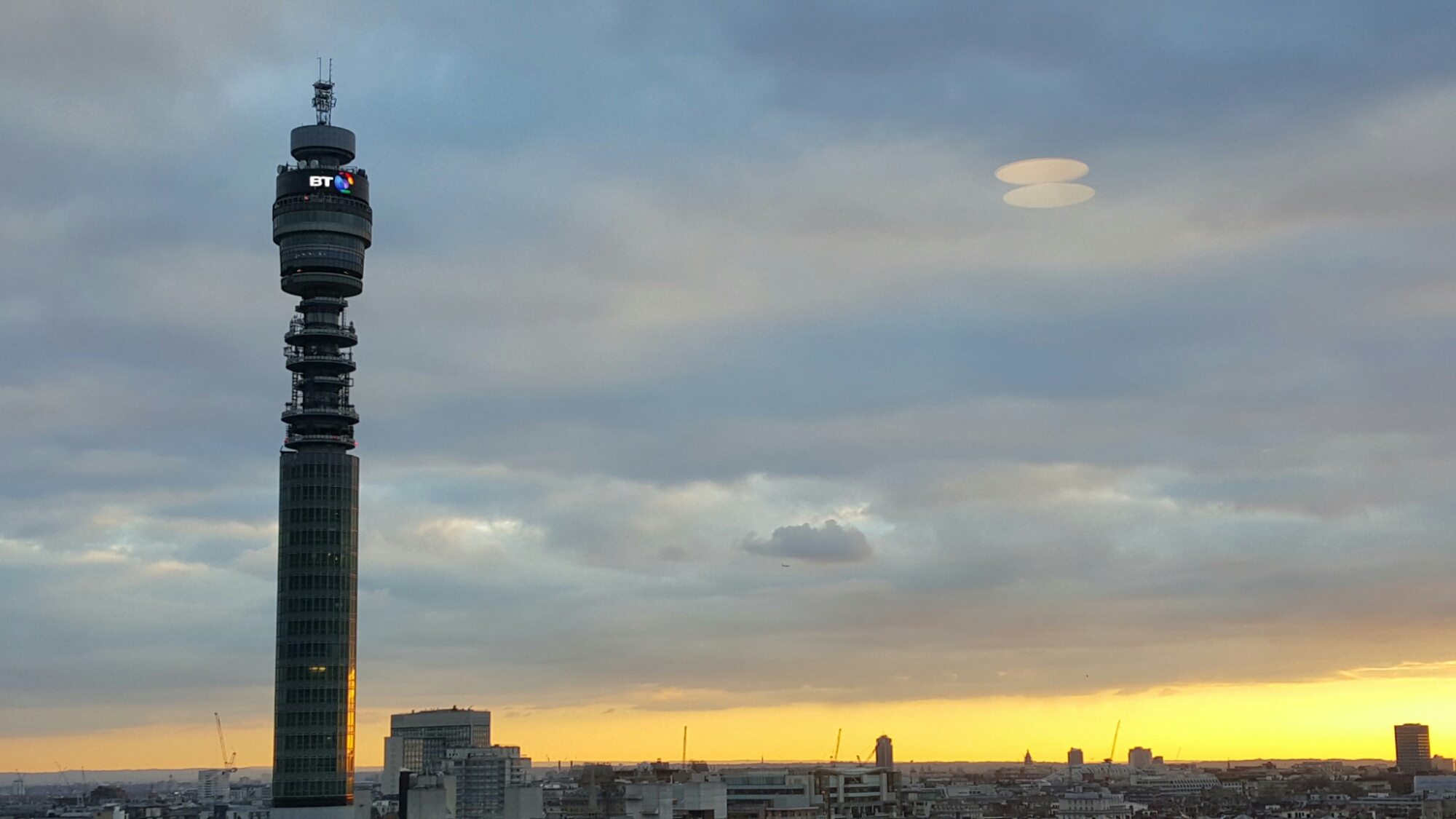
The view of the Euston Road wasn’t bad either:-

The Age of Giorgione (1)
I have been doing background reading for our exhibition, In the Age of Giorgione, which opens on Wednesday to Friends of the RA and on Saturday to the wider public. That the exhibition is happening at all is a triumph of diplomacy by its two curators, Simone Facchinetti from the Museo Adriano Bernareggi in Bergamo and Arturo Galansino, formerly of the RA and now in charge of the Palazzo Strozzi in Florence. There have been previous exhibitions of Giorgione, most recently at the Kunsthistorisches Museum in Vienna. But the presumption is that it should be impossible, given the lack of availability of loans and the general uncertainty of attribution. Arturo originally wanted to do a monographic exhibition on Giovanni Cariani. We all said it was much too specialist. So, instead he has made a virtue of the general uncertainty surrounding Giorgione and it is now the central subject of the exhibition. Who was Giorgione ? And to what extent is it possible to distinguish his paintings from those of his contemporaries ?
The Cloakroom
I have just had what was probably the most stressful morning I have spent at the RA. I was working in the cloakroom on a wet Saturday morning during one of the busiest exhibitions we have ever had. I had forgotten how completely cack handed I am. Also, I had never experienced how many coats people expect to leave – coats, jackets, bags, rucksacks, newspapers, gloves, scarves, umbrellas and hats (what to do with the hat ?). It’s nearly impossible to find the sleeves on the more elaborate coats, which most of them are, in a jungle of fake fur. Then, the bags go in lockers while the coats go on hangers. After a bit, the place fills up so it’s hard to find a hanger. As one takes the hanger out, the coat next door falls off. Someone asked me if I was looking for diamonds in the pockets. On the contrary, I was just trying to find a way to hang her coat up. It made me full of admiration for the calm and sang froid with which the others – artists – behind the counter operated.
Maggs Bros.
I went last night to what I thought was the grand re-opening (it was the grandest invitation) of Maggs Bros in its new premises on Curzon Street opposite Trumpers, the royal barbers. But it turns out that it has been open since Christmas. I scarcely penetrated its magnificent former town house on the west side of Berkeley Square as it always felt too forbiddingly antiquarian even for a bookaholic like me. But the new premises is more easily visited with the best library steps that I have seen, a yellow lacquer library table designed by Marianna Kennedy, saucy French pornography on the top shelves and an unexpectedly strong holding of twentieth-century Japanese photography.
The Garden Bridge (2)
I realise from the ferocity of the comments on my post about the Garden Bridge what strong feelings it arouses.
I would merely comment:-
1. As attentive readers of my blog will have read, the idea of a bridge between Temple and the South Bank dates back to the 1940s when it first appeared as an aspiration in the 1943 County of London plan.
2. Much of the thrust of the book published by Mark Fisher and Richard Rogers on The New London in 1992 relates to the opportunities provided by the deindustrialisation of the Thames and the benefits of treating it as a central artery to be enjoyed and appreciated instead of us just turning our backs on it.
3. The exhibition organised by Peter Murray at the Royal Academy in 1996 floated the idea of Living Bridges, which could be inhabited rather than treated as a way of getting from A to B.
4. The area between Blackfriars and Charing Cross can feel slightly dead. Someone told me that Temple underground station is the least used on the network, which I find hard to believe, but is suggestive that Aldwych, Somerset House and Temple could benefit from more convenient access.
5. As I understand it, the bulk of the funding is private apart from an initial investment of £30 million from the Treasury. So, it costs the public purse £30 million which is not disproportionate.
All of this is a way of saying that it represents more than the childhood dream of Joanna Lumley.
 | Charles | Saumarez | Smith |
You must be logged in to post a comment.