The American Ambassador came and spoke at the Royal Academy tonight. I suppose there comes a time when it is not just the policemen, but the Ambassadors who are younger than one. Suffice it to say that Matthew Barzun is extremely nice, intelligent and highly articulate, the son of Jacques Barzun who pioneered cultural history in the US and was an expert on baseball as well as the history of ideas. Matthew conducted a very simple and effective exercise which was to ask each of us to draw what we least liked about the US. Several of us, including me, tried to think of an easy way of drawing its immigration policies, those cold, inhospitable halls by which one is required to enter the US. As many people drew guns which is easier. I hadn’t realised that there are as many guns as there are American citizens, whereas in the UK only 6% of the population owns guns. The non-resident Americans all tried to draw the IRS. The other thing expressed was a view that Americans are arrogant which I thought was a touch discourteous to someone who was so courtly and unarrogant.
Tag Archives: England
Learning to Draw
I have been asked to select my ten favourite paintings from the collections of the Royal Academy as a way of advertising the benefits of online browsing of the collection on the BBC website Your Paintings (http://www.bbc.co.uk/arts/yourpaintings/). I initially thought that I would just choose the ten most famous paintings, partly inspired by seeing so many of them displayed in the exhibition, Genius and Ambition, in the grand Victorian galleries at Bendigo in Australia. But you don’t necessarily need the website to find out about Constable’s Leaping Horse. What I like about the website is that it is easier to find out about paintings that even I did not know existed because they are kept in store (once we have our new building open in Burlington Gardens I very much hope that more of them will be shown).
I thought that I would start with a painting which I found myself looking at during a long meeting earlier this week. It’s attributed to Zoffany, but not entirely convincingly (1781 was the year he exhibited his great group portrait of the The Sharp Family) and shows The Antique Room of the Royal Academy at New Somerset House (03/846).

The Antique Room of the Royal Academy at New Somerset House, 1780 – 1783. (c) Royal Academy of Arts
It shows a group of students drawing from the already extensive collection of classical casts – the so-called Plaster Academy – not long after the Royal Academy’s new building was opened in Somerset House. The now ageing Keeper, George Michael Moser, is said to be overseeing the class, but it doesn’t resemble the caricature of him by Rowlandson. The picture has an earnestness to it which gives a sense of the appeal of the Academy in its early days, the opportunity to learn to draw by candlelight under the supervision of established artists and with their guidance, and their passionate interest in copying from the antique.
Strike Day
Today I’ve got an all-day meeting in King’s Cross. The journey was not half so easy. I decided to walk through the early morning mist along the canal. The rest of London had decided to do the journey by bicycle. It was like being in the middle of a bicycle marathon, children on bicycles, dispatch riders, racing bicyclists, Boris bicyclists, all ringing their bells as they rushed past en route to Canary Wharf. Suddenly the sun shone.

The District Line
There are benefits in living on the District Line when it comes to strike days. I remember reading in John Lanchester’s admirable short book book about it that the older drivers graduate to the District Line in order to enjoy the long journeys above ground between Bromley-by-Bow and the green fields of Upminster at one end and out to Wimbledon at the other instead of having to endure the deep bore tunnels of the Northern Line. This means that, when everyone else has to endure long traffic jams and queues for the buses, the citizens of Stepney can travel as normal from Stepney Green undergound station, purling through Cannon Street and Embankment to Charles Holden’s stately headquarters at St. James’s Park.
Crazy Coqs
Last night we were invited to the end-of-the-run show for Miss. Hope Springs, the resident drag queen, who has presided at Crazy Coqs, the cabaret bar which has been preserved beneath what used to be the Atlantic Hotel and is now Whole Foods. As the last show in what has been a two-year run, it was a nicely over-the-top combination of songs which were coarse, boisterous and sometimes sentimental.
Dame Jane Mico
My attention was caught whilst out walking this morning by an inscription on the side of the Victorian almshouses to the south of Stepney parish church which revealed that they were the gift of Dame Jane Mico in 1691. LADY MICO’S ALMSHOUSES FOUNDED AND ENDOWED UNDER THE WILL OF DAME JANE MICO RELICT OF SAMUEL MICO CITIZEN AND MERCER.
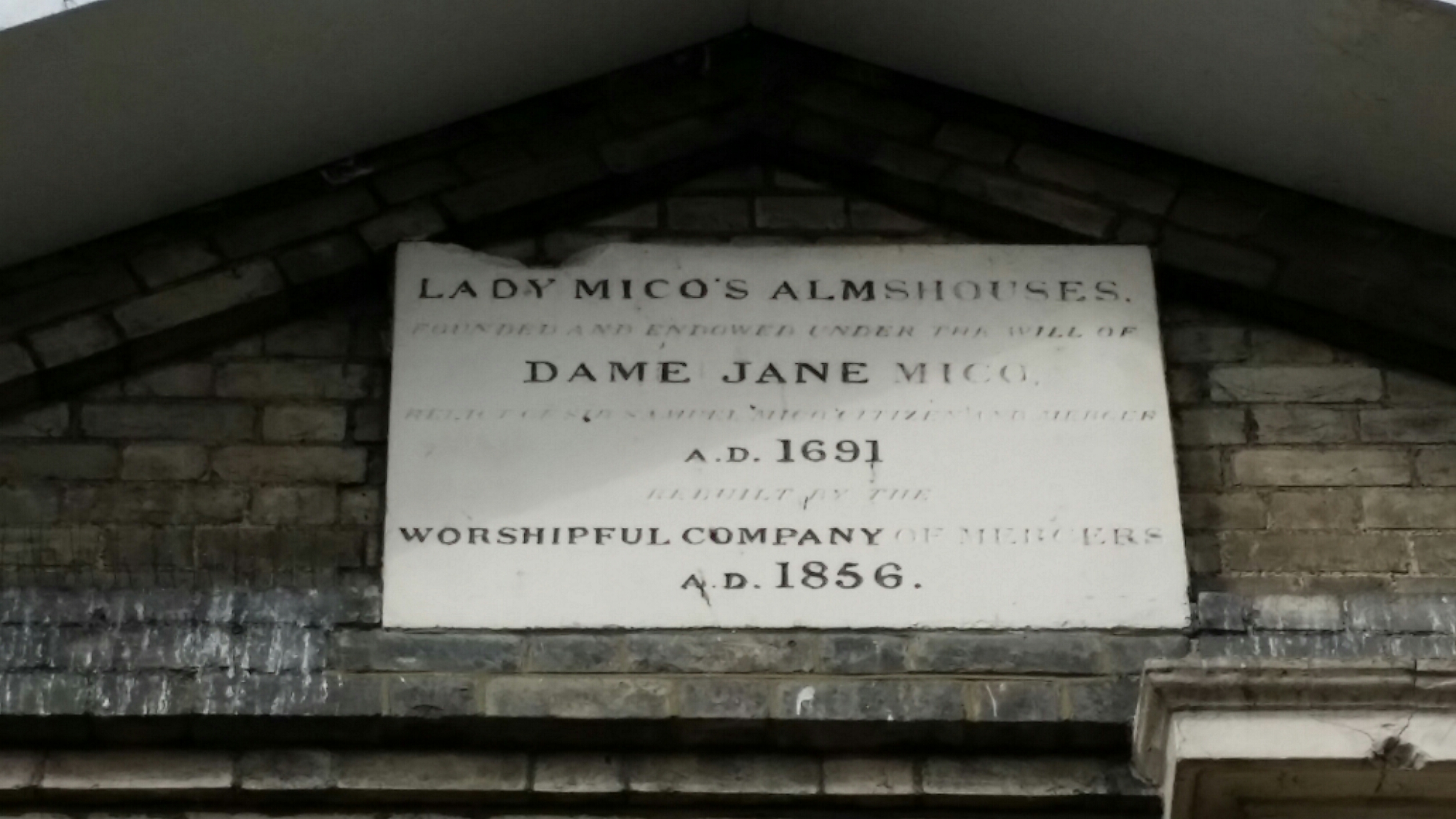
Who she ? Her husband, Sir Samuel Mico, grew rich on the profits of the Levant Company and East India Company, importing silks. He also (surprisingly since he was a pure Londoner) owned the George Inn in Weymouth. When he died in 1665, he split his estate between his widow Jane, his nephew Samuel, the Mercer’s Company, and the town of Weymouth, which celebrates his memory every year with lemonade and hot cross buns. She in turn drew up her will in 1670, leaving money to multitudes of relations, for ‘the redemption of Christian slaves in Barbary’, as well as for 10 poor widows of the city of London who were to be housed in her Almshouses. They remained there until 1976 when they were moved to new accommodation in Whitehorse Lane. She left funds to her nephew which he could not claim because he failed to marry one of his cousins as specified. The funds accrued until they enabled the establishment of a teacher training college in Jamaica. Continue reading
Hubert Saumarez Smith
I have been prompted by the correspondence with my hitherto unknown cousin Ben Heywood (see comments) to take an interest in the life of my grandfather Hubert. I realise how little I know about him. He died in 1950 before I was born. My mother used to say he was a saintly character and there was always an implied contrast to his wife Muriel, who used to wear a hat for dinner. He spent nearly his entire adult life as the vicar of All Saints, Waldershare, a church in rural east Kent which was declared redundant in 1980. As far as I understand it, his only parishioner was the Earl of Guilford. An enthusiastic freemason, he sent my father to Winchester, but educated my aunt Margaret at home. She got a first class degree in English so the education must have been good.
Hugh Trevor-Roper
We’ve all been reading – and enjoying – the letters of Hugh Trevor-Roper, which I bought when they came out, but haven’t had time to read hitherto. I was brought up to regard Trevor-Roper as lazy, never producing any historical work of deep significance after his early biography of Archbishop Laud and his book on The Last Days of Hitler which he wrote on instructions as an operative for MI5 (although I remember admiring The Rise of Christian Europe which I read as an undergraduate). Yet ever since his death in 2003, works have been pouring out from his estate, including the two volumes of letters so far published and the possibility of up to ten more. They reveal him as magnificently well connected, worldly and waspish.
ALVA
I have just been to an event organised by ALVA, which represents a weird and wonderful mixture of organisations from the British Museum to Canterbury Cathedral and anything in between which attracts more than a million visitors a year, including the Royal Academy. Bernard Donoghue, its Chief Executive, gave an admirable short speech summing up his experience of the issues of the day in which he said what a great pleasure it was to be holding a conference in an institution (the RA) which treated its friends not just for transactional purposes, but to widen and deepen their enjoyment and participation in the arts. I found this deeply interesting because we have just undertaken a survey which suggests that 83% of our Friends join the scheme for specific benefits and only 17% as a gesture of philanthropic support for the organisation. So the question is: is membership for pure benefits, an essentially commercial transaction? Or is it underpinned by a deeper value system ? As the argot goes, is it about value or values ? I would be grateful for any advice on this question.
Turk’s Head Club
I’ve just realised that tomorrow is the 250th. anniversary to the day of what Joshua Reynolds called the Turk’s Head Club, others called (at least later in its life) the Literary Club, and was sometimes referred to, at least by Samuel Johnson and his friends, as just the club (although confusingly Reynolds has entries in his pocketbook referring to his attendance at ‘Club’ long before the Turk’s Head Club was established). It was set up by Joshua Reynolds so that his and Samuel Johnson’s close friends could enjoy each others’ company on a regular basis – in fact, every week in an upstairs room on Monday evenings in the Turk’s Head tavern in Gerrard Street, where they were looked after by the publican Charles Swinden. The site of the tavern still exists and is now a Chinese supermarket. So, tomorrow night we should all raise a glass to Samuel Johnson and his friends, who included Oliver Goldsmith and Edmund Burke. Not a bad club, I think.
 | Charles | Saumarez | Smith |
You must be logged in to post a comment.