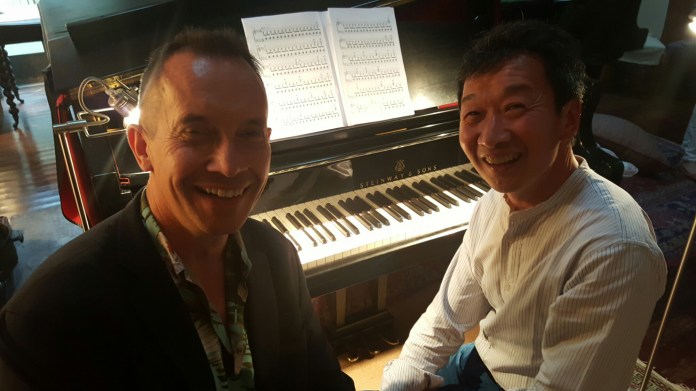
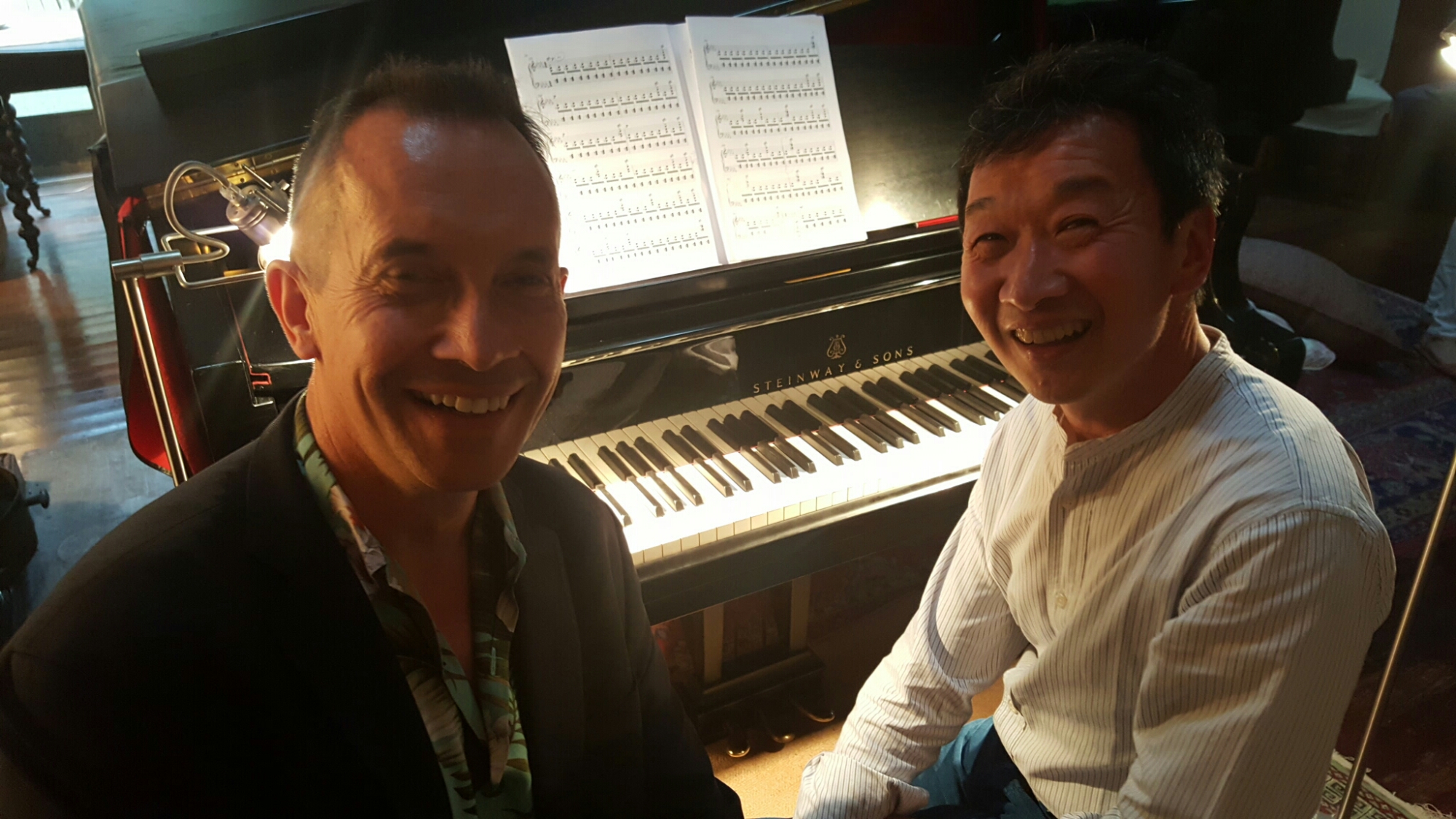
In a moment of mad enthusiasm, I decided to attend a wedding party on the Appian Way, which was fine in theory, only the British Airways flight was delayed a couple of hours, so I missed the actual ceremony. But I was able to enjoy the Appian Way as the sun went down, the gypsy band and the assembled multitude of wellwishers from all over the world:-
Category Archives: Uncategorized
Hockney Portraits
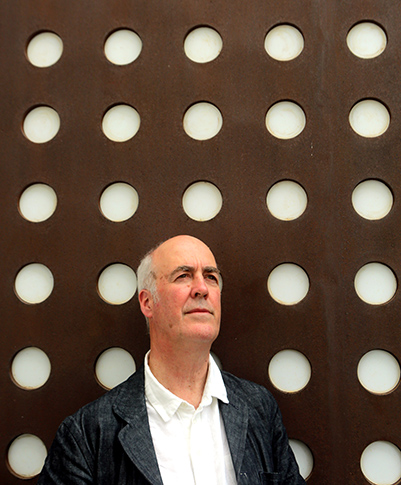
Our Hockney exhibition opened tonight: oddly compelling, because it’s very unusual to see the results of a short period of an artist’s oeuvre all displayed in chronological order together; and because it’s life enhancing to see friends, family and the local dry cleaner all displayed democratically in the same format. The only person I was able to photograph in front of his portrait was Martin Gayford, the art critic who has acted as Hockney’s interlocutor and amanuensis:-
David Hockney RA: 82 Portraits and 1 Still-Life
2 July 2016 – 2 October 2016
RA Schools
I have spent a lot of time in the last week in the Royal Academy Schools, enjoying the final exhibition of the students to mark the end of three years postgraduate study. This year, for the first time, they opened up the old Architecture Room, which hasn’t been used for the study of architecture since the mid-1950s, but which still retains behind its temporary walls Sir Thomas Lawrence’s collection of architectural casts, which he must have bequeathed following his death in 1830:-
St. George’s, Campden Hill
I went to a memorial service this afternoon for Lisa von Clemm, a grand stalwart of the bookbinding community who we first met in the summer of 1988 on an island off the coast of Maine (her husband, Michael, was responsible for Canary Wharf). The service was held in St. George’s, Campden Hill, a bit of Victorian Torcello in Notting Hill, designed by Enoch Bassett Keeling, a so-called ‘rogue architect, in a style which was known as ‘eclectic gothic’, with good polychromatic brickwork on leafy Aubrey Walk:-
Glyndebourne
Just to prove that normal life does still go on in amongst the speculation as to who is going to be the next leader of the Conservative Party and now who on earth can take over from Jeremy Corbyn, I am posting photographs of the roof of Michael and Patty Hopkins’ great opera house at Glyndebourne, one of the most subtle combinations of the rural and the metropolitan:-
And the view across the lawns to the South Downs:-
Brexit (7)
Two further unrelated thoughts.
The first thing is that two people, who are themselves representatives of London’s über-rich, in recent months have said to me privately that they thought that there was bound to be a day of reckoning because of the increasingly huge discrepancy between rich and poor. It looks likely that some form of reckoning may have to come out of the current turmoil.
The second is that the Brexiteers consist of an ultimately incompatible coalition between the right wing of the conservative party – free market, post-Thatcherite, anti-protectionist nationalists – and the heartlands of old Labour – pro-labour, anti-immigrant, anti-Blair nationalists. The latter certainly won’t get what they want if the former are in power.
Brexit (6)
I’ve been touched by the number of comments on my post yesterday, which was indeed no more than a sense that we need a period to reflect on the implications of what has happened. I have been reading much more comment than usual: a very good piece in yesterday’s Guardian by Ian Jack on the reasons for the alienation of the old working class in northern council estates; and a piece sent by Otto SS by the admirable Cambridge historian Peter Mandler in an online magazine called Dissent (www.dissentmagazine.org/blog/britains-eu-problem-london-problem). I recommend them.
Brexit (5)
I’m afraid that I have suspended all normal transmissions while, like everyone, I am trying to get used to a post-referendum world in which it looks as if Boris Johnson may become Prime Minister and Scotland leave the Union. I was asked by someone if there was any advice I could give or anything one could usefully do. I haven’t the foggiest, except wait and see. It’s unexpectedly stormy weather, which seems appropriate, and the garden is lit up in an intense afternoon light after the rain:-
Brexit (4)
Oddly enough, I have been more troubled by the Vote to Leave in Wales than I have in England. I keep thinking of Wales as it was in the mid-1970s when I first got to know it: fiercely nationalistic, quite different from England, and poor. It feels as if it has been developed very significantly through EU, as well as Whitehall, subsidy – made more prosperous, with new roads and infrastructure. Now, it’s European, part of a much wider culture. It has its own pavilion in the Venice Biennale. What will happen ? It’s a version of the issues for England, but somehow more extreme. People think extreme nationalism can’t and won’t come back. But it can.
Brexit (3)
I suppose it would be irrational not to make some sort of comment on the results of the vote and on the mood of sombreness, in spite of the weather, in my morning walk across the park: what it’s like to wake up and discover that, once again, the psephologists and great majority of political commentators have got their analysis wrong; and that the Labour heartlands in the north of England and Wales have chosen to vote against the economic benefits of EU funding and the political benefits of collaboration in favour of the extreme uncertainty and potential political dangers, as well as the intolerance, of a vote for Independence.


You must be logged in to post a comment.